
Course Google Professional Cloud DevOps Engineer
duration: 36 hours |
Language: English (US) |
access duration: 180 days |

Details
This training focuses on mastering the DevOps culture, automation and tools within the Google Cloud environment. You will learn how to use infrastructure as code (IaC), how to set up CI/CD pipelines for fast and reliable software delivery, and how to deploy services such as Kubernetes Engine and Cloud Monitoring.
Result
After completing this training, you will have knowledge of DevOps practices and Continuous Delivery (CD) implementation and management on Google Cloud Platform.
Prerequisites
In-depth knowledge of Cloud concepts and experience with Linux and DevOps tools is recommended for this training.
Target audience
System Administrator, Network Administrator, Software Developer
Content
Google Professional Cloud DevOps Engineer
Google Professional DevOps Engineer: Introduction to DevOps Fundamentals
DevOps, a collaborative and integrated approach, promotes the simultaneous involvement of development, operations, and quality assurance teams throughout the software development lifecycle, aligning with modern IT practices to accelerate delivery, enhance reliability, and optimize application quality. In this course, you will learn the foundational principles of DevOps, understand its life cycle, and discover the benefits it offers. You'll also explore how DevOps integrates with containers and microservices, synergizes with Agile methodologies, and optimizes software delivery within cloud architectures. This course is one of a collection that prepares learners for the Google Professional Cloud DevOps Engineer exam.
Google Professional DevOps Engineer: CI/CD Architecture Stack in Google Cloud
Embracing the power of continuous integration and continuous delivery (CI/CD) with the Google Cloud Platform (GCP) can accelerate software development, enhance collaboration, and ensure reliable, automated deployment of high-quality applications. In this course, you will learn foundational CI/CD concepts and build robust CI/CD pipelines on Google Cloud Platform (GCP) using native services like Cloud Build and Cloud Deploy. You will explore integrations with third-party tools and strategies for managing multiple environments. Finally, you will implement configuration management, troubleshoot common pipeline issues, and secure your cloud deployment workflows. This course is one of a collection that prepares learners for the Google Professional Cloud DevOps Engineer exam.
Google Professional DevOps Engineer: Applying SRE Practices to a Service
Building and maintaining resilient, high-performing services in Google Cloud Platform (GCP) involves a solid understanding of site reliability engineering (SRE) principles and practices and the delicate balance and implementation of change, velocity, and reliability. In this course, you will learn the foundations of SRE, its core principles, and how to apply them effectively within GCP environments. Gain insights into defining service-level indicators (SLIs), service-level objectives (SLOs), and service-level agreements (SLAs), while exploring strategies for managing the service life cycle, capacity planning, and autoscaling. Develop an understanding of incident response, postmortem analysis, and toil reduction. Finally, discover how to foster collaboration, prevent burnout, and drive continuous improvement using feedback loops. This course is one of a collection that prepares learners for the Google Professional Cloud DevOps Engineer exam.
Google Professional DevOps Engineer: Implementing Service Monitoring Strategies
Optimization of applications and infrastructure in Google Cloud Platform (GCP) can be achieved by effectively managing logs and metrics and leveraging Cloud Logging and Cloud Monitoring. In this course, you will learn how to effectively manage logs and metrics within GCP using powerful tools like Cloud Logging and Cloud Monitoring. Master the configuration of the Cloud Logging agent, explore log collection from various sources, and learn to create custom metrics. Gain proficiency in setting up monitoring dashboards, configuring alerts based on service-level objectives (SLOs)/service-level indicators (SLIs), and comparing GCP's Prometheus offering with other solutions. Additionally, you'll delve into access controls and optimization strategies for efficient log management. This course is one of a collection that prepares learners for the Google Professional Cloud DevOps Engineer exam.
Google Professional DevOps Engineer: Optimizing Service Performance
You can optimize application performance and reduce costs in the Google Cloud Platform (GCP) by diagnosing and resolving service performance issues and leveraging powerful tools like the Operations Suite, service mesh telemetry, and Cloud Profiler. In this course, you will explore the diagnostics, troubleshooting, and optimization of service performance within the GCP. Investigate the use of GCP's Operations Suite, service mesh telemetry, and Cloud Trace for in-depth performance analysis. Troubleshoot compute, deployment, runtime, and network issues. Discover optimization strategies using preemptible virtual machines (VMs), committed use discounts, and Cloud Profiler. Finally, you will utilize Cloud Monitoring and Error Reporting for effective application management and analyze case studies to streamline resource usage and reduce costs. This course is one of a collection that prepares learners for the Google Professional Cloud DevOps Engineer exam.
Google Professional DevOps Engineer: Google Cloud Platform (GCP) Fundamentals
Google Cloud Platform (GCP), a comprehensive cloud computing platform, offers a suite of integrated services and tools to empower DevOps practitioners, streamline software development lifecycles, and accelerate innovation in the cloud. In this course, you will learn the fundamentals of GCP, including its components, setup, and core services tailored for DevOps workflows. You will also explore the power of automation within GCP, compare it to other cloud platforms, and gain hands-on experience demonstrating its capabilities in common DevOps scenarios. This course is one of a collection that prepares learners for the Google Professional Cloud DevOps Engineer exam.
Google Professional DevOps Engineer: Implementing CI/CD Pipelines for a Service
Becoming skilled in the art of continuous integration and continuous delivery (CI/CD) pipeline design and implementation on the Google Cloud Platform (GCP) includes understanding both hybrid and multicloud environments and how to streamline software development, deployment, and management for enhanced efficiency, reliability, and security. In this course, you will explore the design, implementation, and management of robust CI/CD pipelines on the GCP. You will investigate the role of Artifact Registry in artifact management and identify triggers for CI/CD pipelines on the GCP. You will delve into advanced deployment strategies and the configuration of hybrid and multicloud environments. Finally, you will focus on troubleshooting deployment issues on the GCP and learn how to implement security best practices to ensure the reliability and security of your software delivery process. This course is one of a collection that prepares learners for the Google Professional Cloud DevOps Engineer exam.
Google Professional DevOps Engineer: IaC Practices & Immutable Architectures
Embracing immutable architecture on the Google Cloud Platform (GCP), a powerful paradigm for reliable, scalable, and efficient infrastructure management, and leveraging Infrastructure as Code (IaC) tools like Terraform, Helm, and Config Connector allows for seamless automation and deployment. In this course, you will learn the foundations of immutable architecture, explore IaC practices, and gain hands-on experience implementing them effectively within the GCP. Examine the concepts of immutability, utilize tools like Terraform, Config Connector, and Helm, and find out how to manage the infrastructure life cycle. Finally, you will discover how to implement strategies for creating and managing dynamic environments, transition to immutability, apply version control, and address security considerations. This course is one of a collection that prepares learners for the Google Professional Cloud DevOps Engineer exam.
Google Professional DevOps Engineer: Designing the Resource Hierarchy
Unlocking the power of Google Cloud Platform (GCP) organization involves mastering resource management, security, and collaboration through effective project and folder structuring, enabling you to optimize your cloud infrastructure for maximum efficiency and productivity. Begin this course by exploring projects and folders in GCP. Then, you will discover the principles for project organization, key components of GCP, and strategies for logically grouping resources to reflect business structure, development environments, and security requirements. Next, you will learn how to set up shared networking in GCP and investigate identity and access management roles, permissions, and policies. Finally, you will create and manage a service account in GCP. This course is one of a collection that prepares learners for the Google Professional Cloud DevOps Engineer exam.
Google Professional DevOps Engineer: CI/CD Techniques & Security Practices
You can elevate your CI/CD expertise to the next level by mastering advanced techniques in Google Cloud Platform (GCP), securing pipelines, integrating third-party tools, and navigating complex multi-cloud and serverless deployment scenarios. In this course, you will learn advanced strategies for managing CI/CD pipelines on Google Cloud Platform (GCP), including the integration of popular third-party tools. Delve into security best practices, complex deployments using Cloud Deploy, strategies for multicloud environments, and the role of binary authorization in securing the software supply chain. Explore secret management, vulnerability analysis, and IAM policies within CI/CD workflows. Additionally, learn how to set up CI/CD for serverless applications and optimize auditing and tracking within GCP.
Google Professional DevOps Engineer: Foundations of SRE
Understanding site reliability engineering (SRE) principles, the delicate balance between innovation and stability, and applying SRE best practices on Google Cloud Platform (GCP) allows you to build and manage highly reliable, scalable systems. SRE bridges development and operations, automates tasks, and improves incident response, leading to higher uptime, cost savings, better user experiences, and continuous improvement in IT infrastructure. In this course, you will explore the foundations of SRE principles, key components, and how to apply them effectively for improved service reliability. Then you will examine the concepts of error budgets, service-level objectives (SLOs), service-level agreements (SLAs), and the automation of toil. Next, you will explore capacity planning, autoscaling with GCP tools, service-level indicators (SLIs), and the crucial role of feedback loops. Finally, you will discover various service lifecycle models and the importance of blameless culture and analyze real-world case studies of successful SRE implementations. This course is one of a collection that prepares learners for the Google Professional Cloud DevOps Engineer exam.
Google Professional DevOps Engineer: Infrastructure as Code (IaC) on GCP
Harnessing the power of Infrastructure as Code (IaC) in Google Cloud Platform (GCP) allows you to streamline, automate, and optimize your cloud infrastructure deployment and management while ensuring scalability, reliability, and consistency. In this course, you will learn to define IaC principles, understand the concept of immutable architecture, and discover powerful IaC tools compatible with GCP, including Terraform, Helm, and Config Connector. You'll also gain practical experience implementing IaC on GCP and explore best practices through examples and case studies. This course is one of a collection that prepares learners for the Google Professional Cloud DevOps Engineer exam.
Google Professional DevOps Engineer: Advanced Monitoring & Incident Response
Mastering advanced monitoring and observability techniques in Google Cloud Platform (GCP) allows you to proactively detect, troubleshoot, and resolve issues, thus ensuring the optimal performance, reliability, and security of your cloud infrastructure and applications. In this course, you will learn how to set up, configure, and use advanced monitoring solutions within Google Cloud Platform (GCP), focusing on Cloud Monitoring, Cloud Logging, and VPC Flow Logs. Delve into alerting strategies based on SLOs/SLIs, custom metrics, incident response and mitigation, postmortem analysis, and integration with third-party tools. Explore Prometheus, access controls, and best practices for streamlined incident communication. This course is one of a collection that prepares learners for the Google Professional Cloud DevOps Engineer exam.
Google Professional DevOps Engineer: Performance Tuning & Cost Optimization
Optimizing Google Cloud Platform (GCP) costs and performance helps to ensure your applications run efficiently and effectively without breaking the bank. In this course, you will learn how to analyze, improve, and optimize the performance and cost-efficiency of cloud services within Google Cloud Platform (GCP). Explore performance monitoring using Cloud Trace and Cloud Profiler, cost management strategies like preemptible VMs and committed-use discounts, and optimization techniques for resource scaling and network tiers. Discover efficient use of Cloud Functions, GKE, and strategies for selecting cost-effective compute resources. Analyze case studies and tools for managing cloud expenditures. This course is one of a collection that prepares learners for the Google Professional Cloud DevOps Engineer exam.
Google Professional DevOps Engineer: Managing & Securing Service Accounts
Mastering the secure implementation and management of service accounts in Google Cloud Platform (GCP) allows you to streamline automated tasks, control access to resources, and enhance the security of your cloud environment. In this course, you will learn the fundamentals of service accounts in Google Cloud Platform (GCP), their importance for secure access management, and best practices for their creation and use. Explore how to assign IAM roles, manage keys, audit service account usage, and rotate keys for enhanced security. Delve into real-world case studies, strategies for minimizing risk, and comparisons between service accounts and user accounts. Discover how service accounts integrate with key services like Cloud Build and considerations for multi-cloud environments. This course is one of a collection that prepares learners for the Google Professional Cloud DevOps Engineer exam.
Google Professional DevOps Engineer: Implementing Network Security & Policies
Virtual Private Clouds (VPCs) are pivotal in creating secure, isolated, and scalable network infrastructure within Google Cloud Platform (GCP), ensuring seamless application deployment and data protection. In this course, learn how to design, implement, and manage secure network infrastructure within Google Cloud Platform (GCP) and how to utilize VPCs, firewalls, Cloud Armor, VPC Service Controls, and private connectivity options for robust network security. Next, examine network traffic management with Cloud Load Balancing, strategies for shared and dedicated VPCs, and the crucial role of IAM policies. Finally, explore case studies for common network security challenge resolution, implement logging and monitoring, and utilize VPC Flow Logs for in-depth network visibility. This course is one of a collection that prepares learners for the Google Professional Cloud DevOps Engineer exam.
Google Professional DevOps Engineer: Automating Cloud Security & Compliance
You can strengthen Google Cloud Platform's security posture by implementing continuous compliance monitoring and automated security measures. This helps ensure your cloud environment remains protected against evolving threats and adheres to industry regulations. In this course, learn how to automate security and compliance tasks within Google Cloud Platform (GCP) to maintain a secure and compliant environment, and explore tools like Security Command Center and Web Security Scanner (WSS). Next, learn about Policy Intelligence features, Cloud Functions for streamlined assessments, event-driven responses, and automated remediation. Finally, discover how to integrate third-party tools, leverage managed services like Cloud KMS, and explore a case study on compliance automation. This course is one of a collection that prepares learners for the Google Professional Cloud DevOps Engineer exam.
Google Professional DevOps Engineer: Application Deployment Strategies
Application deployment strategies are vital for Google Professional DevOps Engineers to ensure seamless, efficient, and reliable software releases. Google Cloud Platform (GCP) users who are proficient in deploying and managing applications can leverage its diverse range of deployment models and strategies to achieve optimal scalability, reliability, and availability for their applications, enabling effective resource management, minimizing downtime, and supporting continuous delivery. In this course, you will learn about various application deployment models suitable for cloud-native and hybrid applications within the GCP. You will explore essential factors influencing deployment choices, as well as key GCP services like Compute Engine, Google Kubernetes Engine (GKE), Cloud Functions, and Cloud Run. Then you will compare serverless options and focus on deployment strategies such as blue/green, canary, and traffic splitting. Finally, you will discover rollback techniques, feature flags, principles of high availability, disaster recovery, and microservices for resilient application design. This course is one of a collection that prepares learners for the Google Professional Cloud DevOps Engineer exam.
Google Professional DevOps Engineer: Advanced Application Deployment Strategies
Architecting resilient and scalable global applications on Google Cloud Platform (GCP) can be achieved by leveraging multi-regional deployments, automated pipelines, and container orchestration to deliver exceptional user experiences worldwide. In this course, learn how to create and implement advanced application deployment strategies in Google Cloud Platform (GCP), including multi-regional deployments, global load balancing and traffic management strategies, and using automation tools like Spinnaker and Cloud Build. Next, explore feature flag integration with GCP services, microservices deployment with GKE, and real-world case studies on successful GCP application deployment strategies. Finally, examine how to enhance global application availability and adopt best practices for monitoring deployment strategy impact. This course is one of a collection that prepares learners for the Google Professional Cloud DevOps Engineer exam.
Google Professional DevOps Engineer: Architecture Optimization & Best Practices
Organizations can design and implement high-performing, scalable, and cost-effective cloud architectures in Google Cloud Platform (GCP) by leveraging managed services, serverless computing, and optimized data strategies to drive innovation and business value. In this course, you will learn how to optimize cloud architectures within the Google Cloud Platform (GCP) for enhanced performance, scalability, and cost-efficiency. Discover techniques for using managed services, serverless computing, optimizing data storage and databases, and effectively employing GCP's network features. Learn how to identify optimization opportunities with Google Cloud's operations suite, balance cost and performance, compare architectural patterns, and analyze case studies. Develop a continuous improvement mindset for ongoing optimization. This course is one of a collection that prepares learners for the Google Professional Cloud DevOps Engineer exam.
Course options
We offer several optional training products to enhance your learning experience. If you are planning to use our training course in preperation for an official exam then whe highly recommend using these optional training products to ensure an optimal learning experience. Sometimes there is only a practice exam or/and practice lab available.
Optional practice exam (trial exam)
To supplement this training course you may add a special practice exam. This practice exam comprises a number of trial exams which are very similar to the real exam, both in terms of form and content. This is the ultimate way to test whether you are ready for the exam.
Optional practice lab
To supplement this training course you may add a special practice lab. You perform the tasks on real hardware and/or software applicable to your Lab. The labs are fully hosted in our cloud. The only thing you need to use our practice labs is a web browser. In the LiveLab environment you will find exercises which you can start immediately. The lab enviromentconsist of complete networks containing for example, clients, servers,etc. This is the ultimate way to gain extensive hands-on experience.
Sign In
WHY_ICTTRAININGEN
Betaal in termijnen
| Cursusnaam | |
| Looptijd | |
| Rentebedrag financiering | |
| Totaal bedrag | |
| Maandbedrag |


Gespreid betalen met Spraypay
Met de betaaloptie SprayPay kun je jouw bestelling van € 250,- tot € 3.500,- veilig en gespreid betalen in gelijke termijnen van 12, 18, 24 of 36 maanden. Je hebt op die manier een minimale financiële belasting en je kunt eenvoudig de termijnbetalingen opnemen in jouw vaste lasten.
Hoe werkt het kopen op afbetaling? De beoordeling van de kredietaanvraag vindt online plaats. Binnen enkele seconden weet je of je in aanmerking komt voor een krediet. Is de aanvraag akkoord dan kun je meteen genieten van je aankoop.
Let op: deze betaalmetode is aleen beschikbaar voor particulieren! Bekijk voor je aankoop ook de SprayPay voorwaarden.

Via ons opleidingsconcept bespaar je tot 80% op trainingen
Start met leren wanneer je wilt. Je bepaalt zelf het gewenste tempo
Spar met medecursisten en profileer je als autoriteit in je vakgebied.
Ontvang na succesvolle afronding van je cursus het officiële certificaat van deelname van Icttrainingen.nl
Krijg inzicht in uitgebreide voortgangsinformatie van jezelf of je medewerkers
Kennis opdoen met interactieve e-learning en uitgebreide praktijkopdrachten door gecertificeerde docenten
Orderproces
Once we have processed your order and payment, we will give you access to your courses. If you still have any questions about our ordering process, please refer to the button below.
read more about the order process
Een zakelijk account aanmaken
Wanneer u besteld namens uw bedrijf doet u er goed aan om aan zakelijk account bij ons aan te maken. Tijdens het registratieproces kunt u hiervoor kiezen. U heeft vervolgens de mogelijkheden om de bedrijfsgegevens in te voeren, een referentie en een afwijkend factuuradres toe te voegen.
Betaalmogelijkheden
U heeft bij ons diverse betaalmogelijkheden. Bij alle betaalopties ontvangt u sowieso een factuur na de bestelling. Gaat uw werkgever betalen, dan kiest u voor betaling per factuur.

Cursisten aanmaken
Als u een zakelijk account heeft aangemaakt dan heeft u de optie om cursisten/medewerkers aan te maken onder uw account. Als u dus meerdere trainingen koopt, kunt u cursisten aanmaken en deze vervolgens uitdelen aan uw collega’s. De cursisten krijgen een e-mail met inloggegevens wanneer zij worden aangemaakt en wanneer zij een training hebben gekregen.
Voortgangsinformatie
Met een zakelijk account bent u automatisch beheerder van uw organisatie en kunt u naast cursisten ook managers aanmaken. Beheerders en managers kunnen tevens voortgang inzien van alle cursisten binnen uw organisatie.
What is included?
| Certificate of participation | Yes |
| Monitor Progress | Yes |
| Award Winning E-learning | Yes |
| Mobile ready | No |
| Sharing knowledge | Unlimited access to our IT professionals community |
| Study advice | Our consultants are here for you to advice about your study career and options |
| Study materials | Certified teachers with in depth knowledge about the subject. |
| Service | World's best service |
Platform
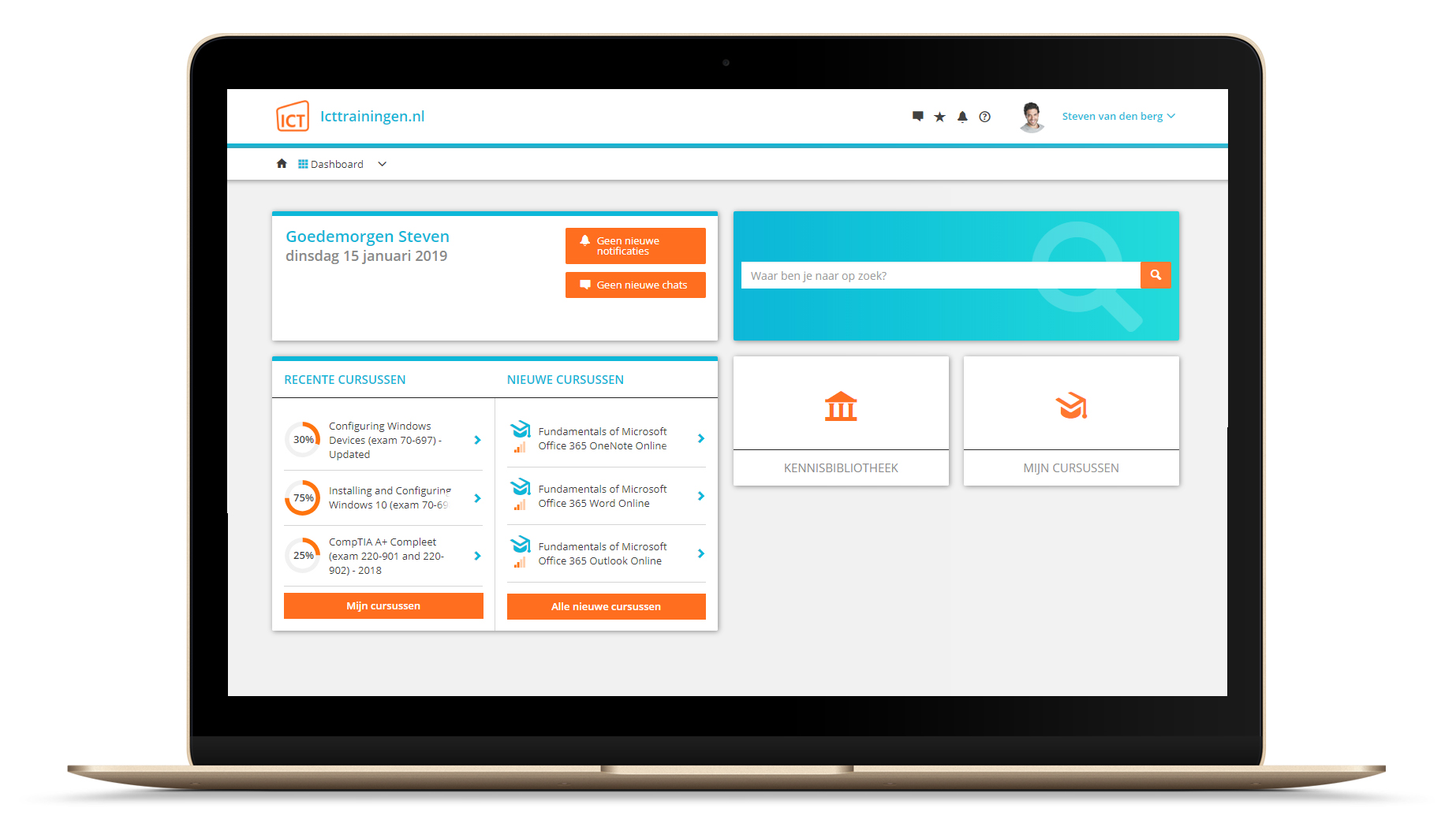
Na bestelling van je training krijg je toegang tot ons innovatieve leerplatform. Hier vind je al je gekochte (of gevolgde) trainingen, kan je eventueel cursisten aanmaken en krijg je toegang tot uitgebreide voortgangsinformatie.
FAQ
Niet gevonden wat je zocht? Bekijk alle vragen of neem contact op.